
How to Recycle Hard Drives and Computer Cables in Chicago: Data Security, Drop-Off Locations & Critical Materials Recovery
How to Recycle Hard Drives and Computer Cables in Chicago: Data Security, Drop-Off Locations & Critical Materials Recovery
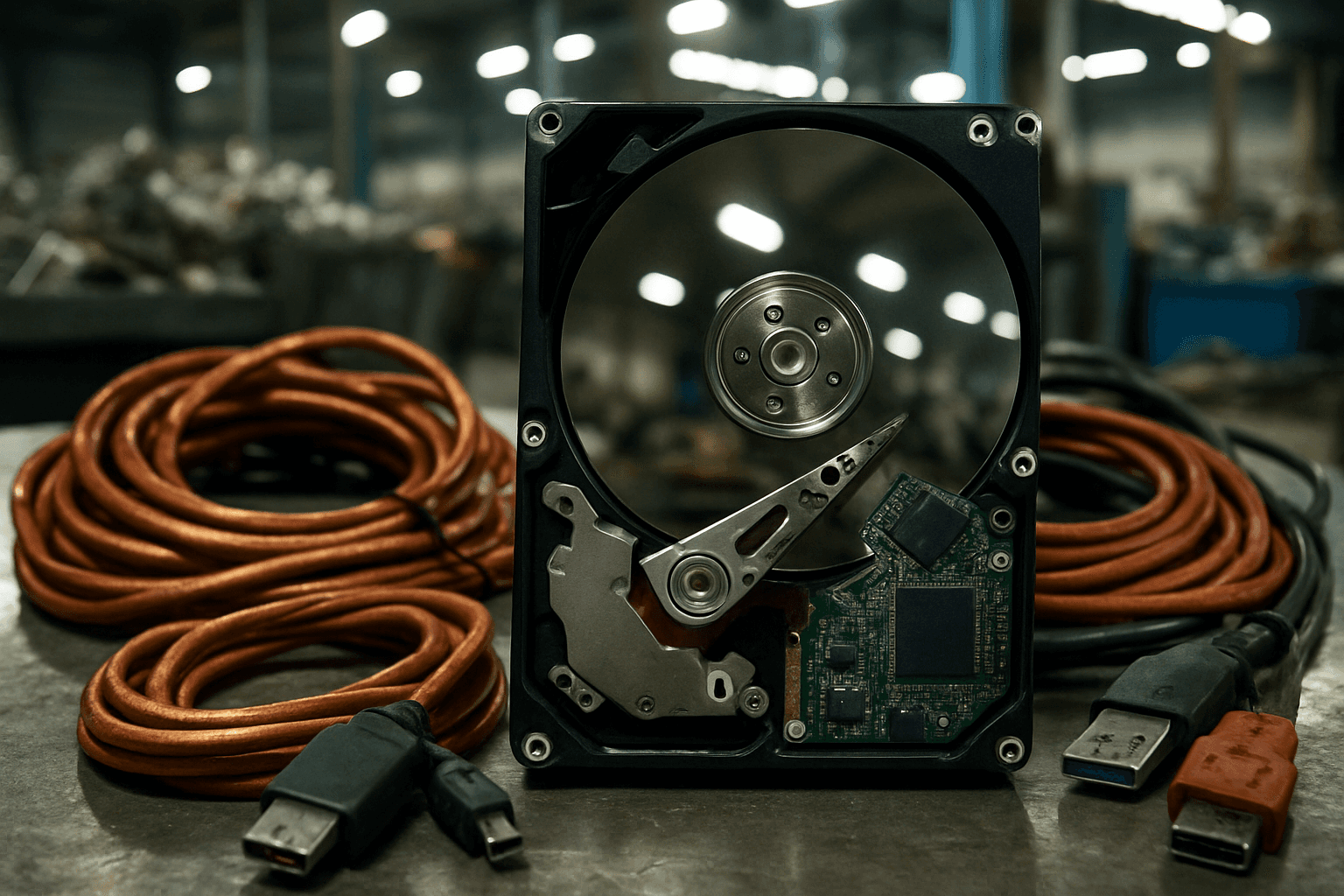
Old hard drives and computer cables contain valuable critical raw materials — rare earth elements, copper, and precious metals that are increasingly hard to source. Recent research from the EU's Joint Research Centre shows that household electronics like hard disk drives and cables represent one of the most significant opportunities for recovering these materials. Here's where to recycle them in Chicago, how to handle data security, and what happens to the materials after drop-off.
Start with the part most guides leave out: this is not optional. Under the Illinois Consumer Electronics Recycling Act, in force since August 2017, it is illegal to throw a set of covered devices in the trash — computers and small-scale servers, computer monitors, keyboards, mice and peripherals, printers, fax machines and scanners, televisions, DVD players, DVD recorders and VCRs, digital converter boxes and cable or satellite receivers, portable digital music players and video game consoles. Manufacturers are required to take part in managing these devices, which is what pays for the statewide collection network.
🔒 Data Security: What to Do Before Recycling a Hard Drive
Before you recycle any hard drive, you need to destroy the data. Physical damage is the most reliable method for personal devices:
Remove the hard drive from the computer — don't recycle the entire tower if you only need to destroy the drive
Drill multiple holes through the platters using a power drill (the metal discs inside the drive)
Use a hammer to physically deform the drive casing and platters
Degaussing services are available at some e-waste facilities for magnetic data destruction
For businesses or property managers disposing of multiple drives, consider a certified data destruction service before recycling. Many commercial e-waste recyclers offer certificates of destruction.
Do not:
Rely on software deletion alone — data can be recovered
Recycle drives with intact platters if they contain sensitive information
Assume "factory reset" is sufficient for business or tenant data
♻️ Where to Recycle Hard Drives and Computer Cables in Chicago
City of Chicago — the permanent facility, not the events
The city's monthly e-waste drop-off locations are on hold until further notice. What is running is the permanent Household Chemicals & Computer Recycling Facility (HCCRF) at 1150 N. North Branch St, two blocks east of the Kennedy Expressway at Division Street, open year round on Tuesdays 7 a.m.–12 p.m., Thursdays 2–7 p.m. and the first Saturday of each month 8 a.m.–3 p.m. There are two buildings on site — the yellow one is for electronics. Check the City's e-waste page before you set off, and go early: once the truck is full, no more electronics are accepted.
Two limits matter. The city's eligible list runs to computers and small-scale servers, monitors, TVs, printers, fax machines and scanners, keyboards and mice, VCRs and DVD players and recorders, video game consoles, portable digital music players, digital converter boxes and cable and satellite receivers — and then states that only the listed items are eligible for recycling. Loose cables are not on that list, so do not turn up with a box of them and assume. Second, this is a household service: businesses and large groups have to work with a private disposal company.
Cook County CHaRM Center — where the cables can go
Chicago sits in Cook County, so Chicago residents qualify for the county's Center for Hard to Recycle Materials at 15800 State St., South Holland. Its computer list names "cables and accessories" outright, alongside laptops, tablets, desktop PCs, flat screen monitors, hard drives, circuit boards, mice, keyboards, power supplies and network devices. It is free to Cook County residents and open Tuesdays 8 a.m.–noon, Thursdays 1–5 p.m. and the 2nd and 4th Saturday of each month 9 a.m.–1 p.m. Commercial and industrial waste is not accepted.
Suburban Drop-Off Locations
Many suburbs host their own e-waste events:
Oak Park: Periodic Saturday drop-offs at Public Works, 201 South Blvd — confirm with the Village that non-residents can use it before you drive out
Forest Park: Check village website for hazardous waste collection days
Call your local village hall for schedules
Retail Take-Back Programs
Several national retailers accept cables and small electronics:
Best Buy — accepts cables, hard drives, and most computer parts (limit 3 items per day per household)
Staples — accepts cables and small electronics during business hours
Bring items to the customer service desk. No purchase required.
Nonprofit Recyclers
One nonprofit route, though it means a drive out of the city — and condition is no barrier:
PCs for People — refurbishes computers and parts for low-income families (any condition — nearest drop-off is 4535 SW Highway, Oak Lawn, outside the city)
Call ahead to confirm what they're currently accepting.
🏢 What About Bulk or Commercial Quantities?
If you manage a property, office building, or business with regular IT equipment turnover, individual drop-off events aren't practical. You need a commercial recycling partner that can handle:
Office cleanouts with multiple computers, monitors, and peripherals
Tenant move-outs that leave behind electronics
Scheduled pickups for ongoing IT refresh cycles
Certified data destruction for HIPAA, FERPA, or other compliance requirements
Documentation and certificates of recycling for audit purposes
🌍 Why Hard Drives and Cables Matter for Critical Materials Recovery
Computer components contain materials that are increasingly difficult to mine and import:
Hard drives contain:
Rare earth magnets (neodymium, dysprosium) used in motors and actuators
Aluminum and steel casings
Precious metals in circuit boards (gold, silver, palladium)
Cables contain:
Copper wiring (high recovery value)
Aluminum connectors
Small amounts of precious metals in USB and HDMI connectors
Recycling these materials reduces dependence on new mining, which is energy-intensive and geographically concentrated in a handful of countries. The EU's Joint Research Centre recently identified household electronics as one of the highest-impact sources for recovering critical raw materials — higher than many industrial waste streams.
📦 How to Prepare Electronics for Drop-Off
Remove batteries from any devices — recycle separately at Chicago Public Library branches or Batteries Plus locations
Separate cables by type if you're dropping off large quantities (not required, but helpful)
Keep hard drives separate if you've already destroyed the data — some facilities have separate processing streams
Don't disassemble components unless you're destroying data — recyclers have specialized equipment for separation
🚫 What You Can't Recycle as E-Waste
CRT monitors and TVs — many facilities charge a fee or don't accept them; check before hauling
Appliances with refrigerants — fridges, AC units, dehumidifiers need specialized handling
What Happens After You Drop Off Electronics?
Certified e-waste recyclers follow a multi-step process:
Manual sorting — devices are separated by type (hard drives, cables, circuit boards, etc.)
Data destruction — drives are shredded or degaussed if not already destroyed
Shredding and separation — materials are mechanically broken down
Material recovery — magnets, metals, and plastics are separated using mechanical and chemical processes
Refining — recovered materials are sold to manufacturers for use in new products
Legitimate recyclers are certified by e-Stewards or R2 (Responsible Recycling) standards, which prohibit export of hazardous e-waste to developing countries.