
How to Recycle Textiles in Chicago: Where to Donate Clothes, Drop Off Fabric Scraps & Keep Clothing Out of Landfills
How to Recycle Textiles in Chicago: Where to Donate Clothes, Drop Off Fabric Scraps & Keep Clothing Out of Landfills
Americans throw away about 85 pounds of textiles per person each year — and most of it ends up in landfills. In Chicago, you've got better options. Whether you're clearing out your closet, dealing with stained or torn fabric, or just trying to keep wearable clothes in circulation, here's where to take textiles and what actually happens to them.
Why Textile Recycling Matters
Clothing and fabric make up roughly 6% of Chicago's waste stream. When textiles sit in landfills, synthetic fibers take decades to break down, and natural fibers release methane as they decompose. Recycling or donating textiles:
Keeps usable clothing accessible to people who need it
Reduces demand for new textile production (which is water- and energy-intensive)
Diverts material from landfills — Chicago sends most of its waste to out-of-state facilities, so less textile waste means lower hauling costs and emissions
Creates local jobs in sorting, resale, and textile processing facilities
The good news: about 95% of textiles are recyclable in some form, even if they're stained, torn, or too worn to donate.
♻️ What Textiles Can Be Recycled or Donated
Wearable clothing (donate to thrift stores or clothing banks):
Clean, gently used clothes in any season
Shoes and boots (tied together in pairs)
Belts, purses, backpacks, and bags
Hats, scarves, and gloves
Coats and jackets (high demand in fall/winter)
Non-wearable textiles (drop off at textile recycling bins):
Stained, torn, or heavily worn clothing
Single shoes or mismatched pairs
Fabric scraps and remnants — call the bin operator first; most can only process these in industrial quantities
Old towels, sheets, and linens
Curtains and tablecloths
Stuffed animals (fabric bodies)
Not accepted anywhere:
Textiles contaminated with oil, paint, or chemicals
Wet or mildewed fabric (dry it first)
Mattresses and pillows — textile bins don't take them; Chicago Textile Recycling lists pillows, sleeping bags and foam among the items it can't process
Carpet and rugs (some facilities take these separately; see construction debris recycling options)
Where to Donate Wearable Clothes in Chicago
If your clothes are clean and in good shape, donation is the best first option. These items get resold locally or redistributed to people in need.
Thrift stores, resale shops and drop boxes:
Goodwill (citywide) — Multiple drop-off locations. Find your nearest at goodwillgreatermc.org.
Salvation Army (citywide) — Drop-off centers and donation bins throughout Chicago neighborhoods.
USAgain drop boxes (citywide) — 24/7 drop boxes and monitored kiosks, including The Brickyard (2600 Narragansett Ave), Ashland and Roosevelt (1220 S Ashland Ave) and East Side Plaza (3448 E. 118th St). They take clothes, shoes, accessories and household linens in reusable condition. USAgain is a for-profit company and doesn't issue tax receipts.
Where to Recycle Non-Wearable Textiles
If your textiles are torn, stained, or otherwise unwearable, don't toss them in the trash. Textile recycling bins accept these items and send them to facilities that shred fabric for insulation, industrial rags, or fiber recovery.
Textile recycling drop-off bins:
Chicago Textile Recycling (a division of Wipeco) — a 24/7 donation bin outside their warehouse at 171 S. Gary Ave., Carol Stream, and a second bin at their old address, 250 N. Mannheim Rd., Hillside. They will take items that are stained or torn: clothing, household textiles such as sheets, towels, drapes and sofa covers, and soft toys. Everything must be clean, dry and in sealed bags — nothing wet, dirty, smelly or severely damaged. Pillows, sleeping bags, rugs, carpet and foam are not accepted.
Closer to home: they partner with more than 50 local resale stores and place bins around the area. Call (708) 544-7247 with your rough location and they will point you to the nearest partner store or bin.
How to Prepare Textiles for Donation or Recycling
For donation (wearable items):
Wash and dry everything. Thrift stores don't have capacity to launder donations.
Check pockets and remove personal items.
Tie shoes together by the laces.
Pack in bags or boxes (not loose).
Drop off during business hours — don't leave items outside after hours (they often get rained on or picked through).
For textile recycling (non-wearable items):
Bag items to keep them dry.
No need to wash stained or torn textiles.
Remove large metal hardware (zippers and buttons are fine).
Drop in designated textile bins, not your curbside recycling cart.
What Happens to Recycled Textiles
Once you drop off textiles at a recycling bin or donation center, here's the typical journey:
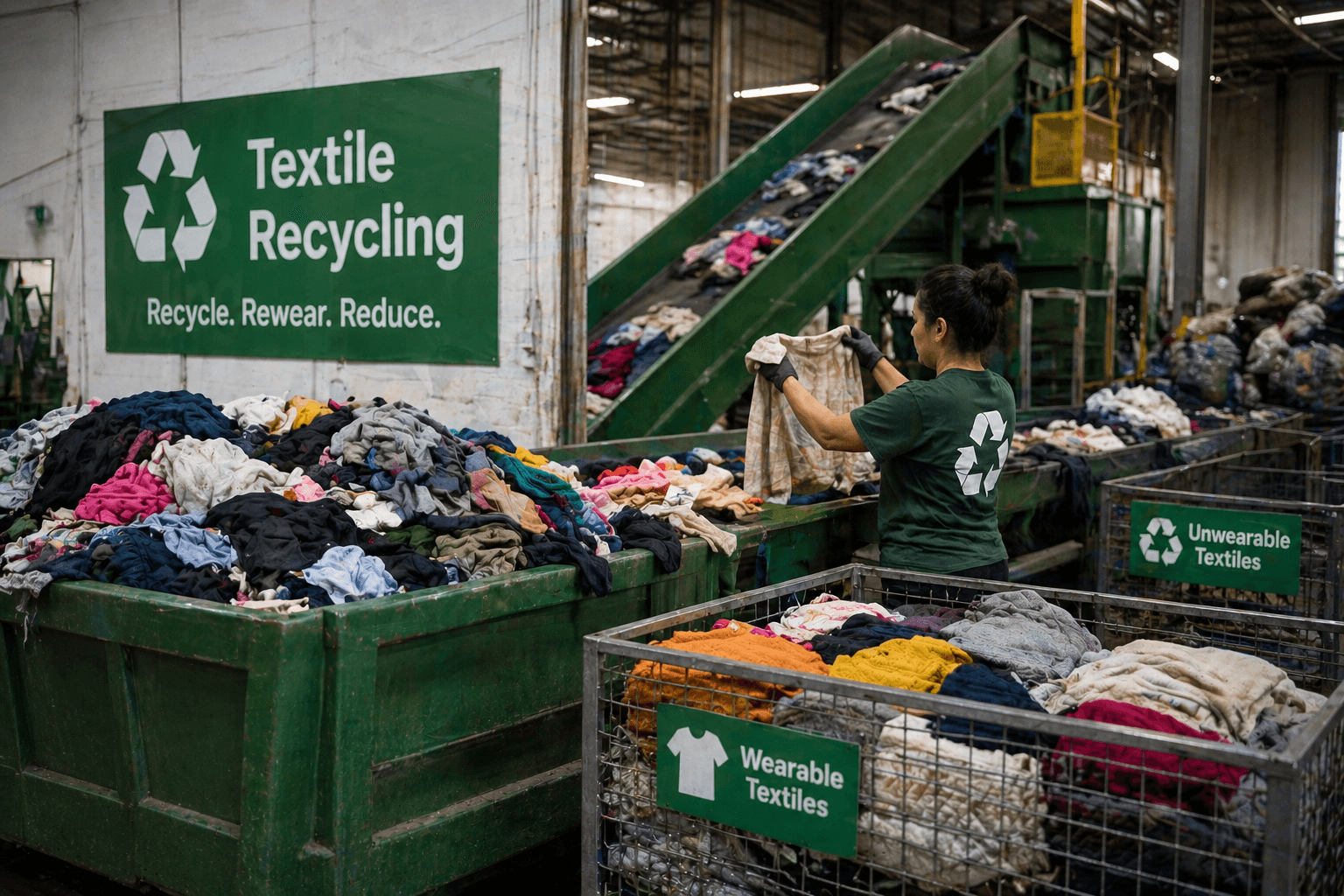
Sorting — Items are sorted by condition. Wearable clothes go to thrift stores or get bundled for resale. Non-wearable textiles move to recycling processors.
Resale or export — About 45% of donated clothing is resold in U.S. thrift stores. Another portion is exported to international markets.
Fiber recovery — Torn or stained textiles are shredded into fibers used for insulation, carpet padding, or industrial wiping rags.
Downcycling — Some textiles are processed into lower-grade products like stuffing for furniture or automotive sound-dampening material.
Chicago doesn't have a large-scale textile-to-textile recycling facility (the kind that turns old polyester into new fabric), but the Midwest has several regional processors that handle material from local bins.
Common Questions About Textile Recycling
Can I put clothes in my blue cart?
No. Textiles tangle in sorting equipment at material recovery facilities and contaminate other recyclables. Always use donation centers or textile-specific bins.
What if my clothes are ripped or stained?
Textile recycling bins accept these. Don't throw them in the trash — even damaged fabric has value as raw material.
Do I need to remove buttons and zippers?
No. Small hardware is fine. Recycling facilities have processes to separate metal from fabric.
What about socks and underwear?
Clean, gently used socks can be donated (high need at shelters). Underwear is generally not accepted for donation but can go in textile recycling bins.
Can I recycle shoes?
Yes. Tie pairs together and drop them in textile bins or donate to thrift stores. Nike stores also accept athletic shoes for their Reuse-A-Shoe program (ground into material for tracks and courts).
Need Textile Recycling for Your Business?
If you're a gym, hotel, salon, or property manager dealing with bulk textiles, uniforms, linens, towels we'd love to talk to you. We work with local textile processors to keep reusable material in circulation and divert waste from landfills.
Call us at (773) 522-0025 to talk through your needs and get a quote.